How to Help Families Evaluate Financial Aid Offers: A Consultant's Checklist

How to Help Families Evaluate Financial Aid Offers: A Consultant's Checklist
Photo by Andre Taissin / Unsplash

Spring is decision season — and for independent college consultants, that means fielding a flood of calls from families staring at financial aid award letters they don't fully understand. The numbers look official, the terminology is confusing, and the stakes feel enormous. Your job is to cut through the noise and help them make a clear-eyed comparison.

Here's a practical checklist you can walk through with every family once the offers start arriving.


1. Normalize the Numbers

Every school formats its award letter differently. Some lead with the total cost of attendance; others bury it. Some list loans as "awards." The first step is translating each letter into an apples-to-apples comparison.

For each school, have families identify:

  • Cost of Attendance (COA) — tuition, fees, room and board, books, personal expenses, transportation
  • Gift aid — grants and scholarships that don't need to be repaid
  • Self-help aid — federal work-study, subsidized and unsubsidized loans
  • Net cost — COA minus gift aid only (not loans, not work-study)

That net cost figure is the real number families should be comparing. Everything else is packaging.

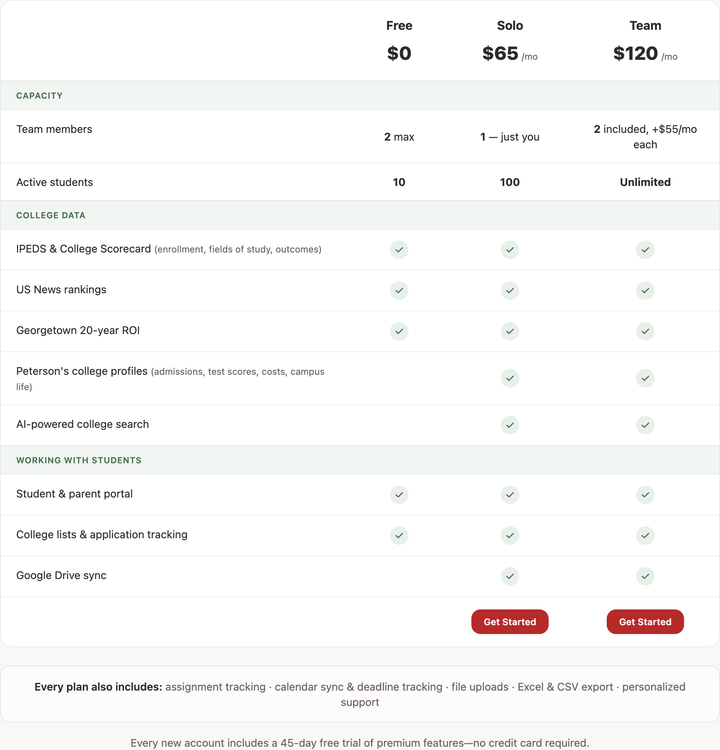
Consultant tip: A side-by-side spreadsheet is the minimum. Better yet, keep all of your college research, cost data, and student information in one place so families can see the full picture without juggling multiple documents. Tools like AdmitPlatform aggregate cost and institutional data from six federal and commercial sources, making it easier to contextualize an award against known averages.


2. Separate Renewable Aid from One-Time Awards

A generous freshman-year package can mask a painful sophomore surprise. For each award, help families answer:

  • Is this scholarship renewable for all four years?
  • What are the renewal requirements — GPA minimums, enrollment status, specific major?
  • Does the amount stay fixed, or does it adjust with tuition increases?

If an award is front-loaded or contingent on maintaining a 3.5 GPA in a competitive program, the four-year cost may be very different from what the first-year letter implies. Calculate the total estimated four-year net cost for each school, not just year one.


3. Understand the Loan Component

Families often don't realize that loans listed in their award letter are debt they're agreeing to take on. Walk through:

  • Subsidized vs. unsubsidized — who pays the interest while the student is in school?
  • Federal vs. private — federal loans have income-driven repayment options and forgiveness programs; private loans generally don't
  • Parent PLUS loans — these are the parent's obligation, not the student's, and they have higher interest rates
  • Total projected debt at graduation — multiply the annual loan amount by four (or more, if the program typically takes longer)

Frame it concretely: "At this borrowing level, the monthly payment after graduation would be approximately $X for ten years." That number lands differently than an abstract loan amount.


4. Factor in the True Cost of Living

Room and board estimates on award letters are just that — estimates. They often reflect the cheapest on-campus housing option, and they rarely account for the realities of upperclassman living.

Have families consider:

  • Is on-campus housing guaranteed for four years, or only freshman year?
  • What does off-campus housing actually cost in that area?
  • Are meal plan costs realistic, or will the student spend significantly more on food?
  • What about travel costs for a student going to school far from home?

A school that's $3,000 cheaper on paper can easily be $3,000 more expensive in practice if it's in a high-cost city with limited campus housing.


5. Look at Outcomes, Not Just Sticker Price

The cheapest option isn't automatically the best investment. Help families weigh cost against what they're getting:

  • Graduation rate — a school with a 45% six-year graduation rate is a financial risk regardless of price
  • Career outcomes — median earnings by program, not just by school
  • Return on investment — how does the total cost compare to projected earnings over 10, 20, or 30 years?
  • Support systems — tutoring, career services, internship pipelines, and alumni networks that affect whether the student actually finishes and thrives

This is where having access to comprehensive institutional data matters. When you're comparing 8–12 schools across multiple students, you need more than Google searches. AdmitPlatform pulls graduation rates, ROI projections, and earnings data from IPEDS, College Scorecard, Georgetown's Center on Education and the Workforce, and other sources — all in one searchable interface. It's the difference between spending an evening assembling a comparison and having it ready in minutes.


6. Know When and How to Appeal

If a family has a legitimate case for more aid, help them navigate the appeal process:

  • Timing matters — most schools have a window for appeals, typically within a few weeks of the award date
  • Lead with circumstances, not complaints — job loss, medical expenses, supporting multiple students in college, a competing offer from a peer institution
  • Be specific — "We received $X more in gift aid from [comparable school]" is more effective than "we need more money"
  • Put it in writing — a clear, respectful letter to the financial aid office with supporting documentation

Set realistic expectations. Appeals sometimes result in a few thousand dollars more in aid. They rarely transform an unaffordable school into an affordable one.


7. Have the "What If" Conversation

Before a family commits, walk through the scenarios they don't want to think about:

  • What if the student transfers — does the aid package travel, or do they start over?
  • What if they change majors — does a department-specific scholarship disappear?
  • What if the family's financial situation changes — do they know how to request a professional judgment review?
  • What if the student needs a fifth year — what does that cost without the scholarship?

These conversations are uncomfortable, but they're exactly why families hire you. Anyone can Google "how to read a financial aid letter." A good consultant helps families think two and three steps ahead.


Keep It All Organized

If you're managing this process across 15, 25, or 50 families at once, the logistics alone can overwhelm the advising. Financial aid season is exactly when things fall through the cracks — a missed appeal deadline, a forgotten cost comparison, a family who went quiet because they were too overwhelmed to ask for help.

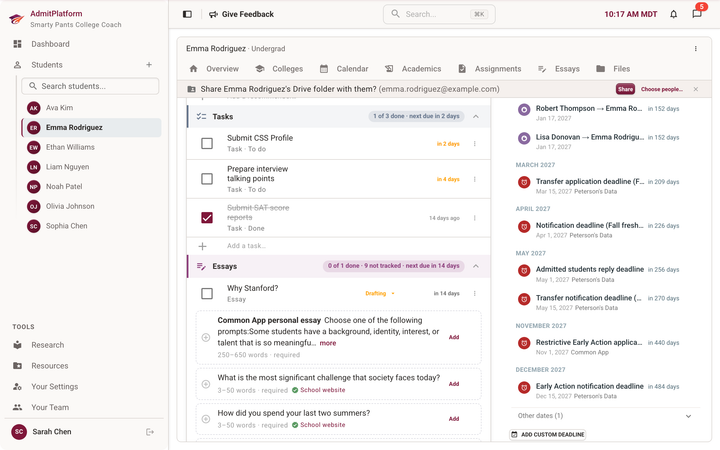
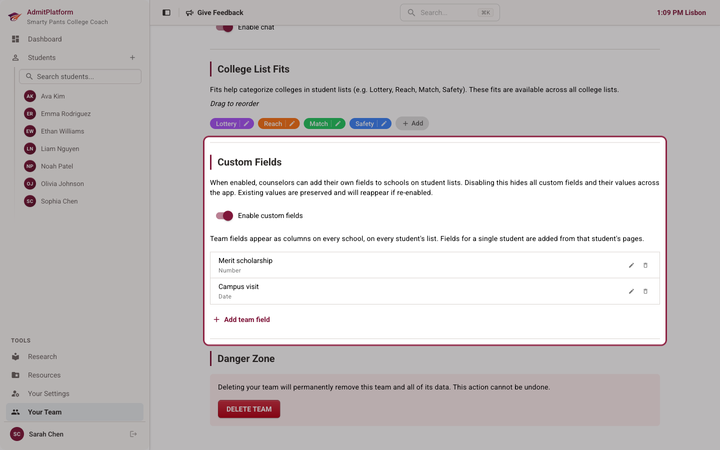
This is where your systems matter as much as your expertise. AdmitPlatform was built for exactly this workflow — not as a generic CRM with college consulting bolted on, but as an all-in-one workspace designed around how independent consultants actually work. Your students' college lists, deadlines, academic records, and institutional data live in one place. Families can see their information through a portal (no account required — just a link and a PIN), which means fewer "just checking in" emails and more time for the conversations that actually matter.

It's free during the beta, with one-on-one support from the development team. If you're heading into decision season and your current setup involves six browser tabs and a spreadsheet, it might be worth a look.


AdmitPlatform is an all-in-one workspace for independent college consultants. College research, student management, family portals, and deadline tracking — purpose-built for the way you work. Try it free during the beta.

Subscribe to AdmitPlatform

Sign up now to get access to the library of members-only issues.
Jamie Larson
Subscribe