What AI Watermarking Means for College Admissions
In some ways, it's not unlike traditional plagiarism detection. The probability that two researchers use the same two words is high. The probability of using the same two sentences, especially complex sentences, is low.

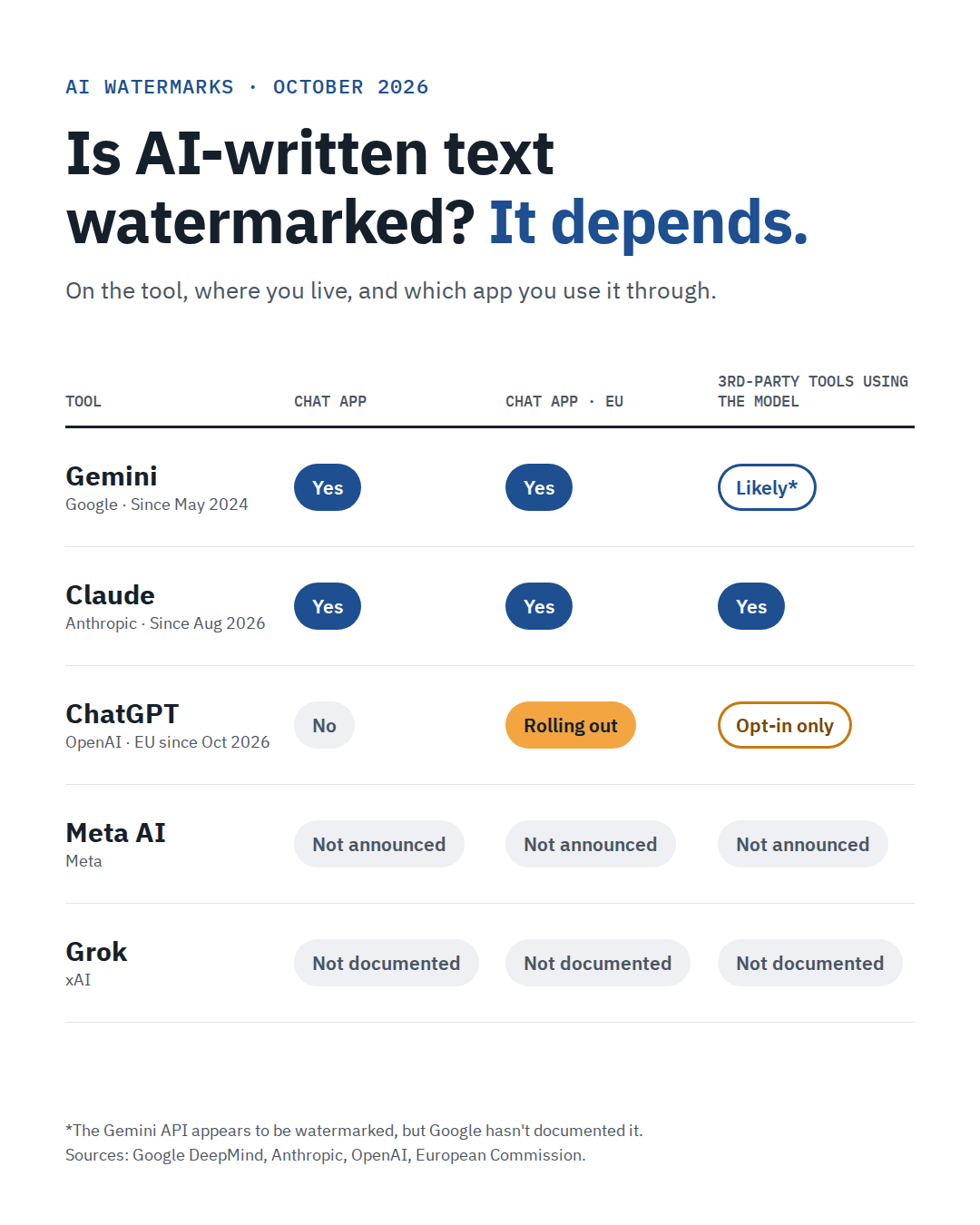
Starting this month, a ChatGPT essay written in Lisbon will carry an invisible AI watermark. Claude's work has already had a watermark globally for weeks now (they announced theirs on August 11). Google has watermarked text Gemini generates since 2024.
I'll explain what this means for college admissions, especially students applying to college and the independent educational consultants who help them.
What to know
- AI watermarking is about the choice of words itself, not any hidden characters or symbols surrounding the words. Pasting without formatting won't help.
- Anthropic's Claude is watermarking most content it generates, worldwide. For now, OpenAI is only doing it for their ChatGPT products in the European Union. Google is watermarking content from its Gemini products.
- You may not know when AI companies add watermarking to their products.
- Watermarks are not completely deterministic. Detection systems, created by the companies that make the AI models, will only give probability scores. The longer the text, and the less human editing, the higher the probability score. The system could say, "we're 99% sure our model was involved" or "we're 10% sure our model touched this."
- Watermarking detects that AI had contact with the text, not that it wrote it. Grammar edits and translation will all carry some AI watermarking. Corrections where the human author chose every word will not be detected, but corrections where an LLM rewords an awkward sentence might, especially if the sentence is long.
- Watermarking is an imperfect technology, but is likely here to stay.
- No watermark doesn't mean "no AI."
How AI watermarking works
Unlike popular "AI detection" gimmicks, AI watermarking doesn't look for “giveaway” words or em dashes. James Padolsey wrote an excellent essay with good visuals explaining exactly how watermarking works, and if you want to understand it in detail, I suggest you read it (disclosure: the essay accompanies a watermark removal tool).
The very truncated version is, as large language models (AI systems) write, when they're presented with a choice of words based on the context, they use a randomizer to decide which roughly equally valid word to use. A watermarking system replaces some of that randomness with statistical preference. One or two words in isolation cannot be detected, but sentences and paragraphs taken together can.
In some ways, it's not unlike traditional plagiarism detection. The probability that two researchers use the same two words is high. The probability of using the same two sentences, especially complex sentences, is low. The probability of two researchers writing entirely identical or nearly identical paragraphs is almost nil. A key difference, of course, is that plagiarism detection works against existing text; AI watermarking is embedded into new text, even if it's the only copy.
What this means for students and counselors
If they aren't already, do expect admissions departments to run every essay through watermark detection software. It is true that right now, not all AI providers are watermarking their output, but more and more will in the future, and you may not always realize when they start. Thus, it's best to assume that anything you have an LLM write probably will be detectable in the future. Will that be considered cheating?
The knee-jerk reaction that "AI is always cheating" is simplistic and only sometimes true. Like human help, AI can be cheating, but it isn't always cheating. But college admissions offices may not see it that way, especially if they perceive deception.
To stay on their good side, it's best to:
- Look for each college's AI policy, if they have one, and follow it. If they don't have an AI policy, it's probably best to assume they frown on it.
- Avoid anything that would seem like deception. If you're an English language learner and you used AI to help translate an essay, disclose that.
- Lean on AI for brainstorming, advice, idea organization, and research. But don't use it for your writing unless it's expressly allowed. You want your own voice to be heard.
- Counselors: Be cautious pasting a student's essay into an AI tool that polishes the writing, as it may quietly watermark its edits.
In spirit of discosure, I used AI to generate the visual table for this post and it checked my grammar along the way.